Business domain
Revolutionizing Delivery Logistics: Last-mile, Food, and Valuable Goods
Uncover the mysteries of last-mile, food, and valuable goods delivery. Transform your business by optimizing the logistics chain for maximum efficiency.

Select your language
Business domain
Uncover the mysteries of last-mile, food, and valuable goods delivery. Transform your business by optimizing the logistics chain for maximum efficiency.
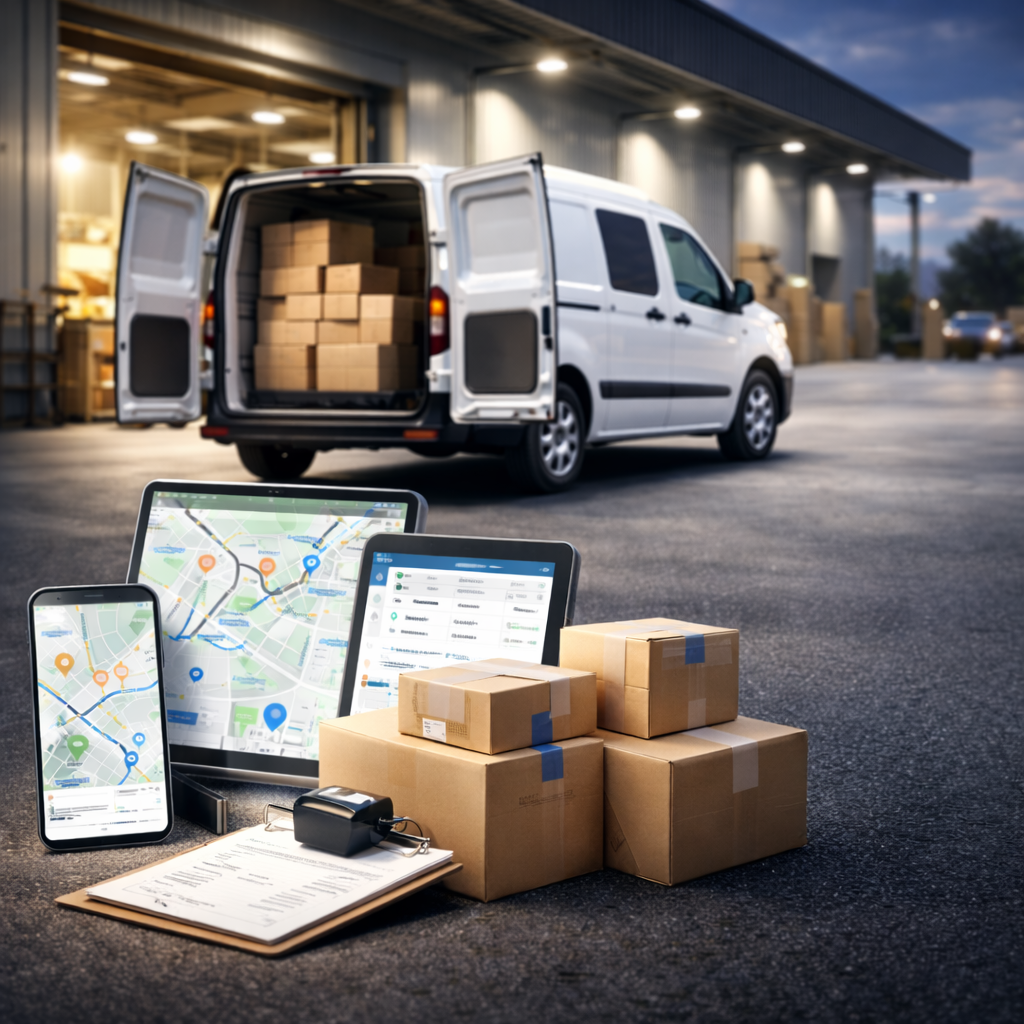
What used to be a linear delivery process is now a dynamic operational system. Decisions must be made in real time — under uncertainty, pressure, and constraints.
This is where traditional dispatching, manual coordination, and static rules fail.
Missed time slots, vague ETAs, and poor visibility directly impact retention and brand perception.
More orders don’t mean proportional growth — they amplify chaos if processes stay manual.
Teams can’t consistently optimize routes, priorities, and exceptions without algorithmic support.
Each delivery model has different priorities, constraints, and optimization logic. Treating them the same leads to inefficiency.
Focused on efficient routing, predictable time slots, and cost control across distributed delivery points.
Time-critical operations where preparation flow and courier coordination directly affect customer satisfaction.
Controlled logistics with strict security, auditability, and continuous dispatcher–vehicle communication.
Automation is not about replacing people — it’s about making decisions consistent, explainable, and scalable under pressure.
Unified rules + data-driven prioritization prevent “manual chaos” and keep dispatch decisions stable, even during peaks.
Real-time monitoring turns delivery into a controllable process — with clear exceptions, accountability, and traceability.
Automation shifts teams from manual coordination to supervision and continuous improvement — scaling operations without multiplying dispatchers.
Want to see where automation would create the biggest leverage in your delivery model?
Validate my delivery model →Same “delivery” label — totally different operational math. This panel helps align expectations before building systems.
We don’t start with “features”. We start with operational decisions: what must be predictable, what must be explainable, and what must be controllable.
Map routes, zones, roles, constraints, SLAs, and exceptions. Identify the “decision points” where humans currently improvise.
Implement rule-based prioritization first, then upgrade to optimization/ML where it creates measurable leverage.
Real-time visibility and audit trails turn “delivery” into a controllable process — with accountability and repeatability.
Standardize decisions across sites and teams. Scale volume without multiplying dispatchers and without turning monitoring into chaos.
Modular platform components you can launch fast — and extend as complexity grows.
Live map, workload view, decision queue, exception handling — everything in one place.
Clear tasks, route guidance, proof-of-delivery, and reliable comms under real conditions.
From deterministic rules to optimization/ML — tuned to your delivery model and constraints.
SLA performance, cost drivers, exception patterns, and continuous improvement reporting.
POS/OMS, marketplaces, fleet systems, payments, notifications — without brittle glue code.
For valuables / regulated operations: access control, auditability, incident readiness.
If your operations are growing, exceptions are multiplying, and dispatch decisions feel “manual” — we can map your model, define control logic, and build automation that scales.
Fast validation · Lean delivery · Clear roadmap & scope
We’ll assess your delivery model (last-mile / food / valuables), identify the decision points that create chaos, and propose automation leverage with a realistic implementation plan.
 Dispatcher workspace
 Courier / driver app
 Optimization & rules engine
 Operations analytics
 Integrations layer
 Security & compliance