When it comes to building custom software, functional requirements usually grab all the attention. It's easy to get pulled in by the tangible pieces — the dashboard, the live monitoring map, the dispatching interface. But for logistics AI platforms built for corporate users, it's the non-functional requirements (NFRs) that actually make the difference.
Functional vs. Non-Functional: The "What" vs. the "How"
A functional requirement might say a system should "let the dispatcher assign a route." The matching non-functional requirement says the system should "complete that assignment within 200 milliseconds, even with 10,000 users online." In an industry as competitive as international logistics, where delays cost thousands of dollars an hour, "how" matters just as much as "what."
Scalability and Performance: Handling the Load of Global Trade
Of all the NFRs, scalability stands out as the most critical. A system that runs flawlessly for a 50-truck fleet but falls over at 5,000 trucks isn't just underperforming — it's a liability. That stakes are especially high for route automation systems.
The primary performance NFRs for logistics include:
- Throughput: Transactions processed per second during the busiest periods.
- Latency: The delay between a user action or sensor signal and the system's response.
- Resource Utilization: The ability to scale without a matching spike in cloud costs.
- Concurrency: Supporting thousands of simultaneous sessions without locking up.
Reliability and Availability: The Cost of Five Minutes of Downtime
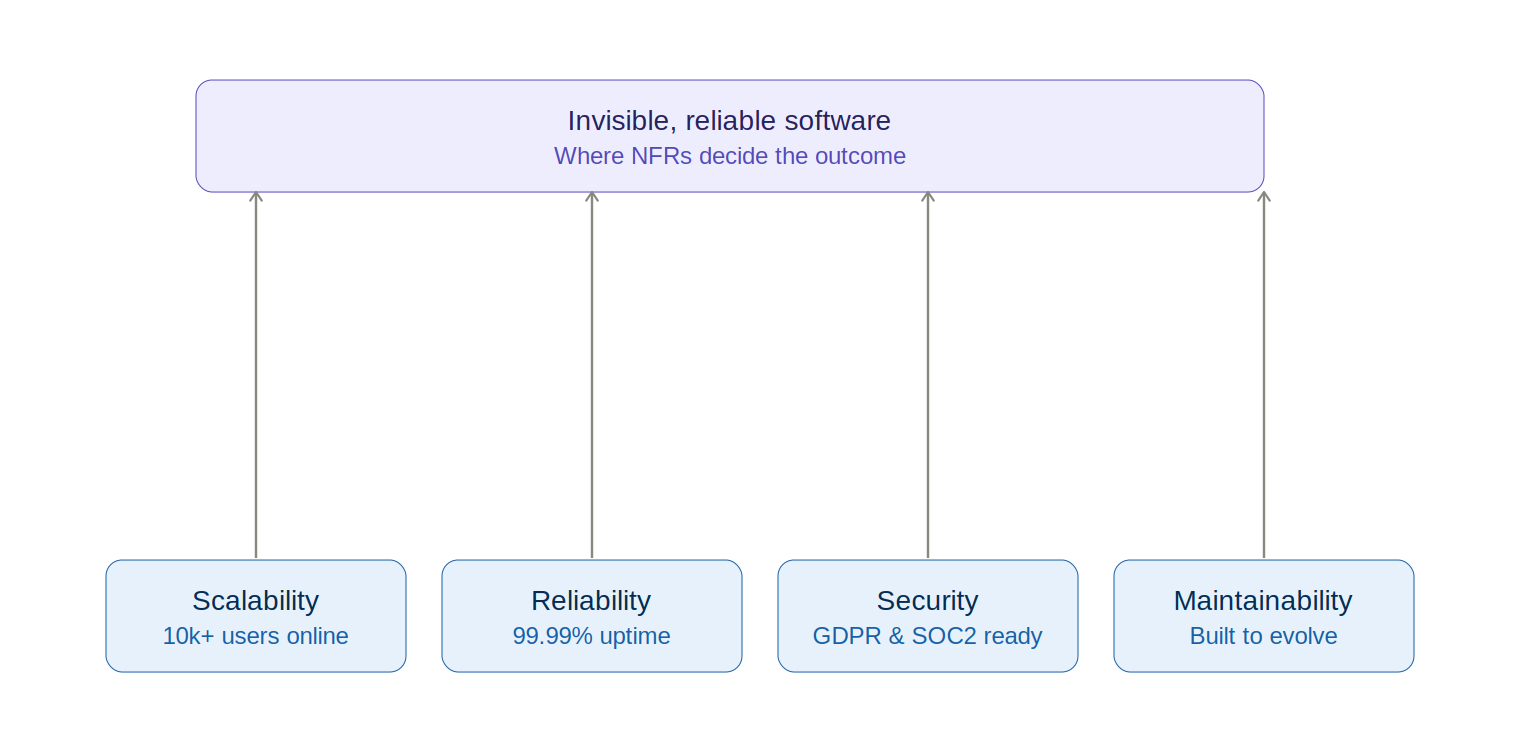
In logistics, the world never sleeps. A custom software solution needs high availability — often targeting "four nines" (99.99%) uptime. Five minutes of dispatch software going offline can create a shipment backlog that takes days to clear.
Security and Compliance: Protecting the Lifeblood of the Enterprise
Security is one non-functional requirement that simply can't be compromised. It covers encryption, multi-factor authentication, and GDPR/SOC2 compliance. In a logistics AI context, data security means protecting every partner and customer across the chain, not just the operator's own systems.
Maintainability: Future-Proofing the Logistics Infrastructure
Given how likely it is that legacy system issues will surface down the line, building a genuinely versatile solution means new technology — autonomous vehicles, for instance — can be added later without tearing apart the existing architecture.
Critical NFR methods for resilience:
- Prioritize Security by Design: Build non-functional security requirements in from the very start of the software lifecycle.
- Set Measurable Metrics: Define NFRs in concrete, testable terms — "99.9% availability," not "should be reliable."
- Monitor Effectively: Use real-time logging to confirm NFR targets are actually being met in production.
- Run Real Stress Tests: Test under real load conditions to prove the software scales before it has to.
Functional features are what make an application attractive to users at first glance — but non-functional requirements are what actually drive business success. A truly expert custom solution is one that operates invisibly, simply because its performance never gives anyone a reason to notice it.
Key Takeaways
- Functional requirements define what a system does; non-functional requirements define how well it does it — and in logistics, the "how" carries the business risk.
- Scalability is the most critical NFR: a system built for 50 trucks needs to keep working at 5,000, not just look good in a demo.
- Key performance NFRs — throughput, latency, resource utilization, and concurrency — determine whether a platform holds up under real load.
- Dispatch systems typically need "four nines" (99.99%) uptime; even five minutes of downtime can create a multi-day shipment backlog.
- Security and compliance (encryption, MFA, GDPR/SOC2) protect every partner in the chain, not just the platform operator.
- Maintainability — building for security by design, measurable metrics, real-time monitoring, and real stress testing — is what lets a system absorb new technology without a rebuild.