
With hyperconnectivity now the norm in 2026, there are virtually no borders left for a logistics organization to hide behind. IoT, cloud-native platforms, and autonomous processes have unlocked tremendous efficiency across the global supply chain — but they've also widened the attack surface considerably. Logistics cybersecurity can no longer be treated as an IT-only concern; it's now a core part of business continuity. A single breach at one warehouse can cost billions in lost sales.
The Digital Frontline: Why Logistics Is the New Prime Target
The logistics industry sits on a goldmine of valuable data — manifests, financial documents, tracking coordinates. That volume of sensitive data makes the industry an attractive target for cybercriminals. When an organization's systems are fragmented, an attack can go unnoticed for weeks.
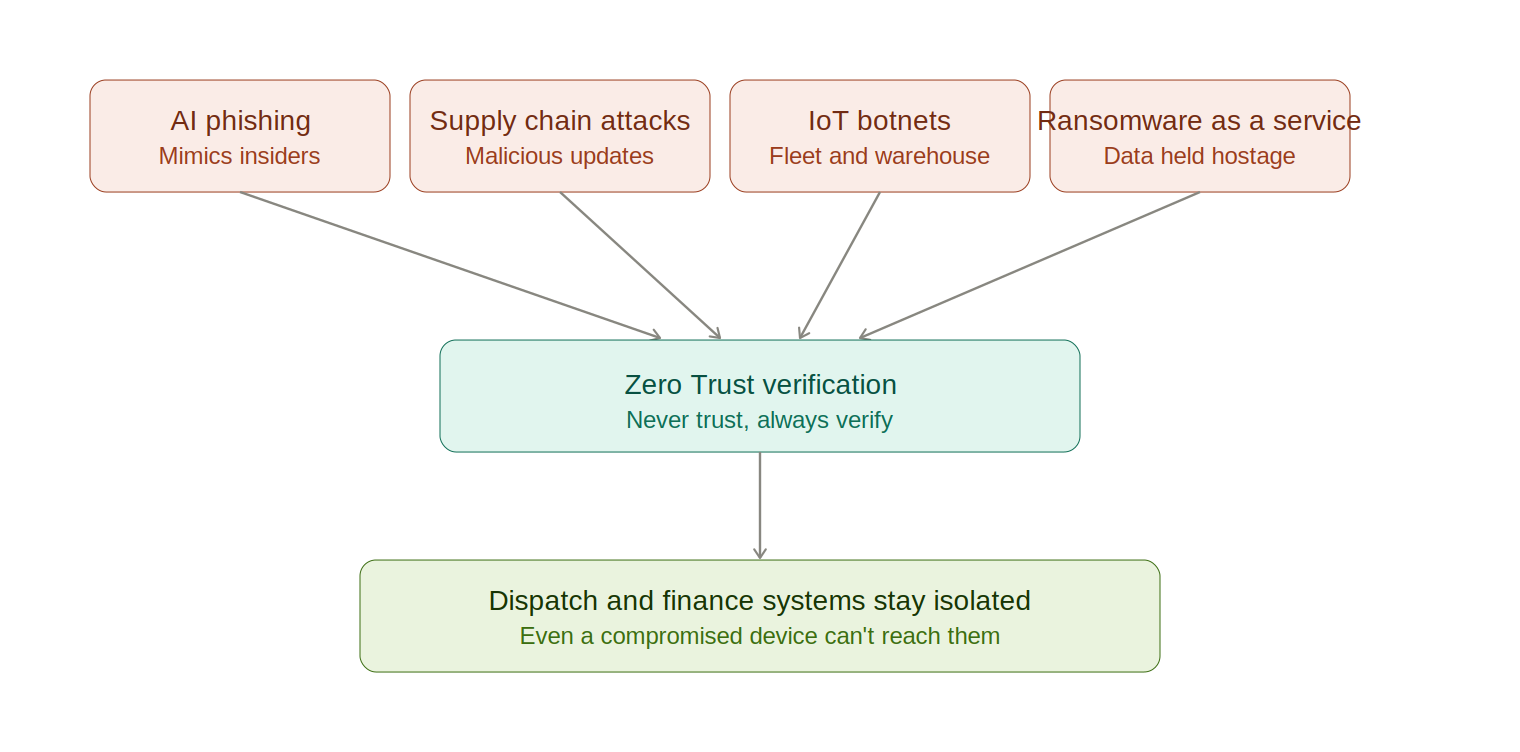
The key cybersecurity challenges facing logistics in 2026 include:
- AI-Powered Phishing: Attacks that mimic internal parties convincingly enough to slip past security filters.
- Supply Chain Attacks: Compromising an external software update server to insert malware upstream.
- IoT Botnet Attacks: Targeting fleet and warehouse sensors embedded in vehicles and buildings.
- Ransomware as a Service: Encrypted malware used to hold logistics data hostage for payment.
AI-Driven Attacks and the Evolution of Ransomware 2.0
We've entered the "Ransomware 2.0" era, where hackers exfiltrate data first and then threaten to publish it. These attacks are increasingly powered by AI that hunts for weaknesses in custom software. Countering that requires the next generation of logistics AI to be able to detect potential threats autonomously, without waiting on a human analyst.
Zero Trust Architecture: The New Standard for Supply Chain Security
Zero Trust runs on one principle: never trust, always verify. The conventional approach lets a user move freely once inside the network — Zero Trust removes that assumption entirely. In a logistics firm running Zero Trust, even a compromised device can't reach the main dispatch software or finance systems.
The Vulnerability of Legacy Systems in a Connected World
One of the most pressing problems logistics companies face today is their dependence on outdated systems that have become genuinely inefficient to secure. These platforms were designed long before today's threat landscape existed, and they simply lack adequate security controls. The only real fix is a secure infrastructure built from the ground up.
A Strategic Roadmap for Enterprise Cyber Resilience
Building a genuinely safe logistics environment requires a shift in leadership mindset — from treating security as a necessary evil to recognizing it as a competitive edge. Once a customer knows their shipment is protected by a real logistics cybersecurity system, no off-the-shelf software can compete with that level of trust.
Strengthening measures for your logistics company:
- Vulnerability Audit: Map every digital asset to identify possible points of intrusion.
- Network Segmentation: Create distinct zones within the network so any intrusion stays contained.
- AI-Driven Monitoring: Build systems that watch network activity continuously through AI.
- Data Encryption: Ensure data is only ever accessible to its intended recipients.
The survival of a modern logistics company depends on its ability to hold its own in an unfriendly digital world. CTOs who look at automation requirements through a security lens are the ones who end up with a genuinely resilient system. The path forward means replacing vulnerable legacy platforms with custom software built on Security by Design principles. Cybersecurity, in the end, is the ultimate form of supply chain resilience.
Key Takeaways
- Hyperconnectivity has erased the traditional perimeter — IoT, cloud-native platforms, and autonomous processes all expand the attack surface at once.
- The top 2026 threats are AI-powered phishing, supply chain software attacks, IoT botnet attacks, and Ransomware-as-a-Service.
- "Ransomware 2.0" adds data exfiltration and exposure threats on top of encryption, and increasingly relies on AI to find weaknesses automatically.
- Zero Trust architecture ("never trust, always verify") stops a compromised device from reaching dispatch or finance systems, even once it's inside the network.
- Legacy WMS and ERP platforms were built before today's threat landscape existed and generally lack the controls to defend against it.
- A practical resilience roadmap runs in order: vulnerability audit, network segmentation, AI-driven monitoring, then end-to-end data encryption.